Garage door repair and service in Montrose, the biggest town on our southern route, where the garages range from old single doors near downtown to three-car doors in the newer subdivisions. Tell us what the door is doing; before any work, you get a free written estimate.
Tell us what the door is doing. The estimate is free and you can say no.
Downtown and the streets around it have older houses with detached garages and single doors. The post-war neighborhoods have ranch houses with one- or two-car attached garages. Out in the newer subdivisions, wide steel doors, often two of them, ride on torsion springs that went in with the house. Each group has its own usual problems, and knowing which one yours belongs to tells the technician what to load.
Say the age of the house and the size of the door when you call. That's usually enough to know whether it's a spring job, a cable job or an opener job before the technician arrives.
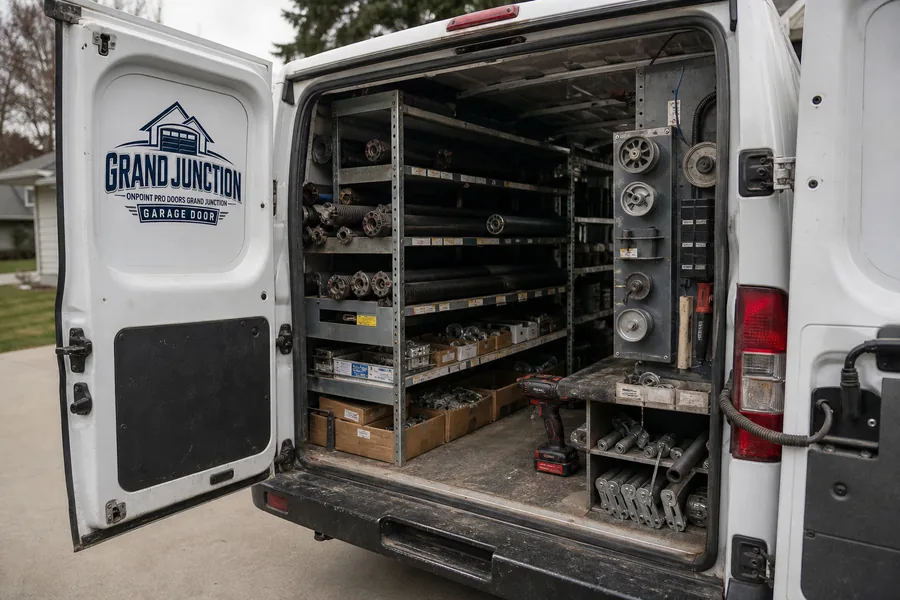
Newer houses are reaching the point where their original springs wear out, because builder-grade springs only last so many trips, and a busy family uses them up. When one breaks, the other isn't far behind, so both are replaced and matched to the door's weight as it stands, not just copied from the label on the old ones.
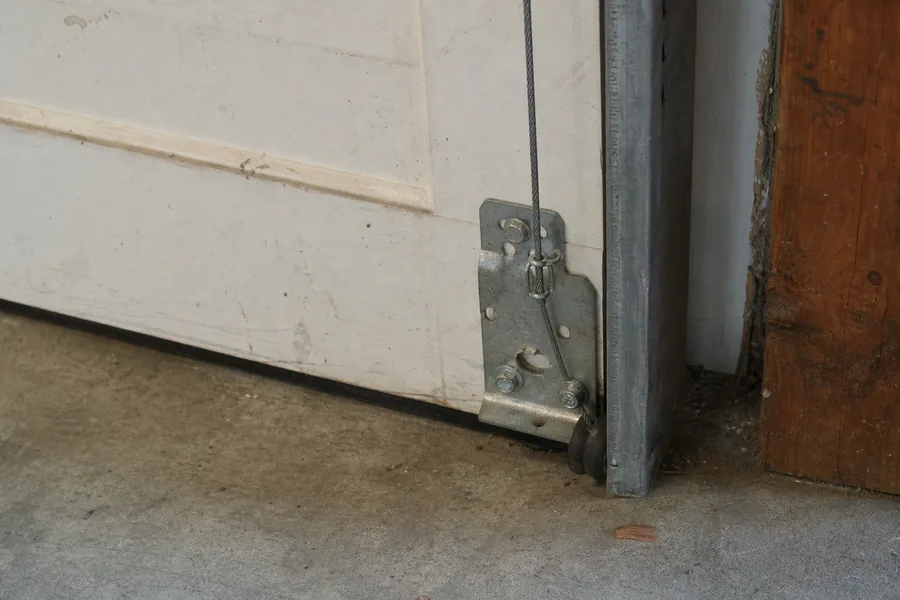
The older ranch houses often have a single door on extension springs above the tracks, or a torsion spring that has been replaced once already. Those doors come back nicely with a full service: new springs with safety cables, fresh rollers, tightened hinges and a door that closes square. An extension spring without a safety cable through it gets one, so a future break stays contained.
What the technician does, in order.
Plenty of newer houses have Wi-Fi openers that talk to a phone app, and when those stop connecting it's usually the home network, not the opener. Older openers fail in more ordinary ways: a stripped gear, a dead board after a storm, safety eyes bumped crooked by a bicycle. Each is a repair; a new opener comes up only when the old one isn't worth the parts.
Spring winds push hard on wide doors, and a double door without struts can flex enough to jump a roller out of its track. Dust blows into the tracks and grinds at the rollers. A door that's grown noisy or catches at one point is usually telling you one of those things.
Clearing grit from the tracks, swapping worn rollers and adding a strut across the top sections of a wide door are all quick fixes that keep a small problem from turning into a door hanging off its track.
An opener built before rolling-code remotes can have its signal copied; newer ones change the code with every press. A release shield on the opener trolley keeps the emergency release from being hooked from outside, and the lock button on the wall control stops every remote from working while you're away. On a door with windows, frosted glass hides what's inside. Any of these can be added during a visit.
Several dented sections, steel rusted through, or a door that's simply the wrong size for the vehicles now using the garage are good reasons to replace it. Measurements come first, then the choices, and the old door is removed once the new one is hung.
Garage doors on rental houses tend to get hard use and little attention until something breaks. A tenant can report the problem and let the technician in, and the owner or manager sees the written estimate and approves the work before anything is done. A door on a rental is also worth a yearly look, since tenants rarely mention a spring that's starting to fail.
Once a garage turns into a woodshop, a home gym or a place to work on the truck, the door matters more. An insulated door and tight seals make it usable through the winter, windows in the top section bring in daylight, and a quieter opener is easier to live with when someone is working a few feet away. A keypad by the door means no digging for a remote with dirty hands.
Olathe and Delta to the north, Ridgway to the south, and the county roads in between are all covered by the same truck. Give us the address and you'll get a time window that allows for where you are.
If the door is getting heavy or the springs show rust or gaps between the coils, replacing the pair on a planned visit beats a surprise one. The technician can check them on any visit.
Usually the opener lost the home network after a router change. The technician gets it back online and checks the remotes while there.
Worn rollers, dry hinges or dust in the tracks, most often. A service visit fixes most of it.
Yes. First the door is made safe, then the cause is found, and then it's rehung. Leave the opener off until then.
Yes, measured on site, with the choices explained before anything is ordered.
Yes: a release shield, the opener's lock setting, a rolling-code opener if yours predates them, and frosted glass on door windows.
No. It's free and written, and the decision is yours.
One call or the form books the visit. You're told when to expect the technician, who also phones when leaving.
Before any work, you get the estimate in writing, free, and the decision is yours.
A two-hour window instead of a whole day, and a call before the technician leaves. Free throughout Mesa County. The estimate is free either way.
Want to talk instead? Call (970) 238-2833.
Tell us what the door is doing. The estimate is free and you can say no.