
OnPoint Pro Doors repairs the big doors around Grand Junction: shop and warehouse sectionals, rolling steel doors, equipment and orchard buildings, storage units, and the operators that run them. The estimate is free, and the figure is yours before any work begins.
Tell us what the door is doing. The estimate is free and you can say no.
A commercial door is a working machine. On a busy shop it might run from first light until the last truck is in, and when it stops, the work behind it stops too. The repair calls that come from businesses in the valley cover every kind: insulated sectional doors on shops and garages, rolling steel doors on warehouses and loading areas, roll-up sheet doors on storage units and outbuildings, and the grilles that close over storefronts.
Each type has its own weak points. Sectional doors wear springs, cables, rollers and hinges like a house door, only faster and under more weight. Rolling doors wear their barrel springs, their guides and the slats at the bottom of the curtain. Sheet doors wear their springs and latches. The first step on any call is a look at the whole door, since the part that failed is often a symptom of something else.
Farm and orchard buildings need room for tractors, sprayers and trucks, and the doors that close them are tall and wide. A door like that carries a lot of weight on its springs and a lot of wind on its face. It needs heavier-gauge track, reinforced hinges, struts across the back to keep the sections flat, and springs wound for its full height and weight.
When one of those doors starts running crooked, binding at the same spot or slamming the last foot, the cause is usually in that hardware: a spring that has lost its pull, a cable fraying on a drum, a track nudged out of plumb by a piece of equipment. Catching it before harvest is far better than finding out mid-season with the door stuck halfway.
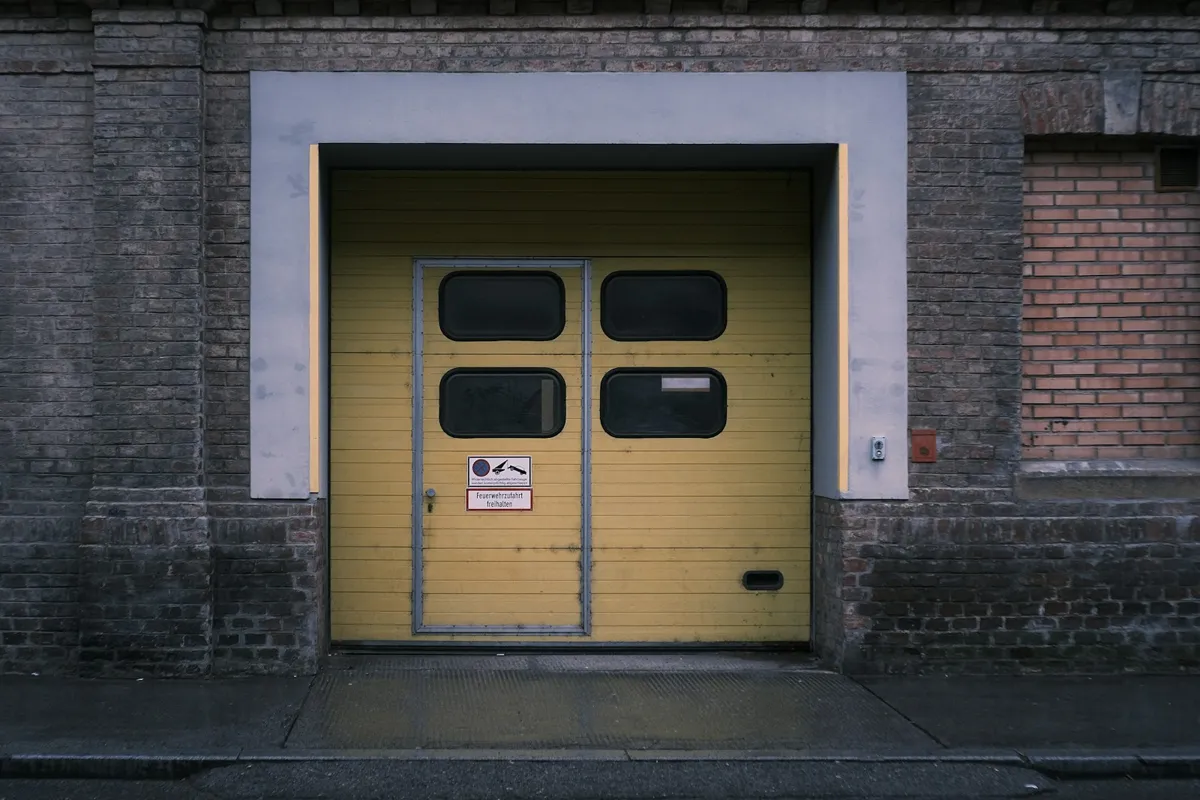
The fine dust that blows through the valley every spring works its way into tracks, rollers and the bearings at the ends of the spring shaft. On a door that cycles all day, that grit acts like sandpaper, and worn rollers start to wobble and bind. Sealed rollers on steel stems hold up far better, and they go on as a set when the old ones are worn.
Sun and cold nights are just as hard on the rubber. Bottom seals and jamb weatherstrip bake, stiffen and split, and once they do, dust and drafts come straight in under a door that otherwise looks fine. Fresh seals are a routine add-on to a commercial visit, handled together with whatever brought us out.
Three kinds of operator cover most business doors in the valley. A trolley unit tows the door along a ceiling-hung rail. A jackshaft unit bolts to the wall next to the opening and rotates the shaft that holds the springs, leaving the ceiling free for lifts and racks. A hoist unit runs a rolling door and keeps a loop of chain beside it for raising the curtain by hand when the grid is down.
Late-summer thunderstorms bring lightning and short outages, and an operator's board is where a surge tends to land. A dead operator, one that answers the wall station but not the remotes, or one that has forgotten where to stop are all common after a storm, and boards and controls for the common brands come on the truck.
The beams that watch the doorway and the pressure-sensitive strip on the door's bottom edge get tested on every call, and so does the button station: up, down and stop each have to do what the label promises.
A shop that can't be locked overnight goes to the front of the day's work. Say so when you phone, and the first aim is a secure building; if a part has to come in to finish the repair properly, that happens on a second visit.
A door frozen shut with equipment, stock or a customer's vehicle stuck inside gets the same priority. Doors still raised by a hand chain or by muscle can usually take a motor later, and that is a smart moment to renew worn springs too, so the new operator begins with a door that balances.
From a single door to a building full of them, the sequence doesn't change.
Storage lots run on roll-up sheet doors: one corrugated curtain wrapped around a drum, with a spring inside that drum and a latch at the bottom. They are simple, and they fail in simple ways. Springs lose tension until the curtain feels like lead, latches bend, and the curtain creases where a tenant's dolly or bumper caught it.
A lot owner usually has more than one door waiting at any given time, so the visit covers the list rather than a single unit. Each door gets its spring tension, latch, curtain and guides looked at, and the written estimate shows which ones need work now and which can wait.
Shops in Clifton and along the business corridors in town, orchard and farm buildings toward Palisade and Fruita, storage lots, auto shops and storefronts, and outbuildings out past Loma, Whitewater and Mack all get the same visit and the same inspection.
Visits to businesses are timed to the way the business runs, keeping each bay down as briefly as we can. The truck carries springs, cables, rollers, seals and operator parts for the common doors, so most repairs wrap up without a return trip.
Yes. Barrel springs, curtain slats, guides, the bottom bar, and the hoist or motor that drives it are all part of the work.
It is worth a visit before it gets worse. A crooked door usually means a spring, a cable or a track problem, and running it that way can damage the sections.
Usually, yes. A dented or creased section is swapped by itself, and the rest of the door stays in service.
Call and tell us. A secure building is the first goal, and anything that needs an ordered part is finished on a follow-up visit.
Most of the time. The springs get looked at during the same visit, so the operator starts out on a well-balanced door.
Yes. Roll-up sheet doors get their springs, latches, curtains and guides repaired, and a lot owner can hand us a list of units to cover in one visit.
Yes. Bottom seals plus jamb and header weatherstrip are renewed on commercial doors, which shuts out dust and drafts.
Nothing. Each door is inspected and the written estimate is free before any work starts.
A two-hour window instead of a whole day, and a call before the technician leaves. Free throughout Mesa County. The estimate is free either way.
Want to talk instead? Call (970) 238-2833.
Tell us what the door is doing. The estimate is free and you can say no.