Automatic gates on long drives and acreage entrances, from the Redlands to the orchards: operators, arms, hinges, rollers and the controls that open them. Most repairs are finished in one visit, and the estimate is free.
Tell us what the door is doing. The estimate is free and you can say no.
If a powered gate on your property has slowed, stalled, started to sag or picked up a new noise, you're in the right place. We look after swinging leaves and rolling sliders alike, along with the operators, batteries, solar panels, keypads and loops that make them automatic.
In the valley that mostly means steel and ornamental iron gates on masonry or steel posts, aluminum sliders across long gravel drives, and a good share of solar-powered operators, since running power out to the end of a long drive is a big job.
Orchard and vineyard properties add wider gates and heavier traffic, and those operators work harder than the ones on a house drive.
Almost every gate call comes back to one of these, and the technician checks them in roughly this order before judging the operator:
A steel double gate is heavy, and every bit of that weight hangs on the hinges and posts all day. When a hinge wears or a post leans, the leaf droops, drags and binds, and the operator has to push harder every cycle until something gives.
In the valley that weight also sits on posts set in ground that moves with the seasons, so a gate that hung true when it went in can be dragging a few years later without anyone touching it.
Sliders fail from the ground up. Heaved concrete under the track, a roller whose bearing has locked, or gravel packed into the channel turns an easy roll into a struggle. Put the gate right and the operator usually recovers.
It runs much like a garage door visit, except more of the time goes into the gate itself before the operator's cover comes off.
Sun and soil set the pace. Heat ages batteries, capacitors and circuit boards, and a panel filmed with dust charges far less than a clean one. Cold nights thicken grease and slow a gate that ran fine all summer.
The ground matters as much. Clay soils in parts of the valley swell and shrink with moisture, and posts set in them lean over the years. A leaning post changes how the gate hangs, and the operator feels it long before anyone sees it.
Wind-blown dust fills slide tracks and coats photo eye lenses, so a lot of gate calls here start with a gate that simply can't see or can't roll.
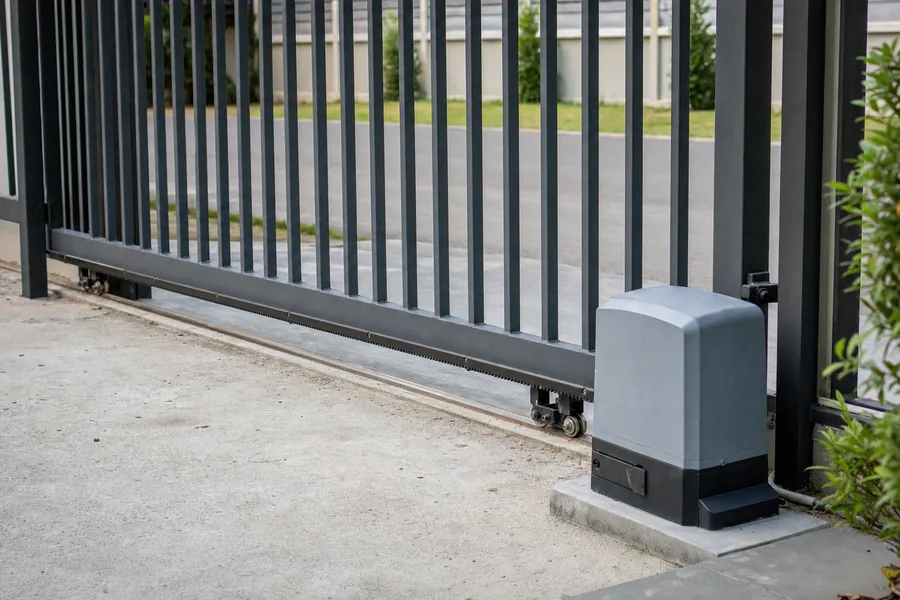
A unit that still runs, whose board can still be bought, and that's rated for the gate's weight should stay. Most breakdowns come down to one component, and swapping it buys years.
New operators are sized to the actual gate, not the brochure. Where there's no power at the post, a solar operator with a panel sized for winter sun is the usual choice.
A replacement goes in only after the gate itself moves freely, because a new operator on a binding gate inherits the same problem.
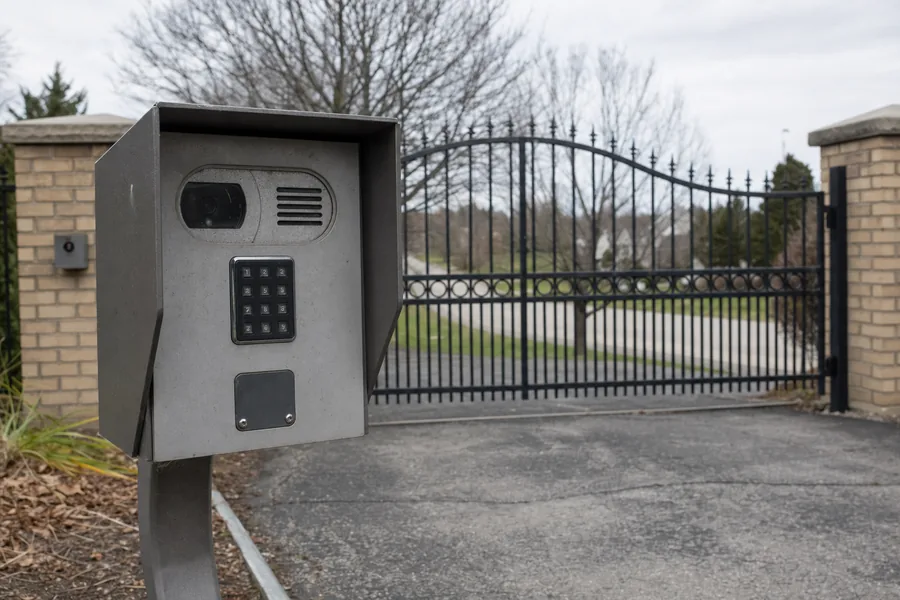
When the keypad opens the gate but the remote doesn't, the gate is fine and the receiver or remote is the issue. When cars heading out get no response, suspect the loop. Telling those apart early saves a lot of guessing.
We handle the control side too: programming, receivers, keypads, intercoms, phone entry and loop detectors, repaired or replaced as needed.
Keypads in full sun take a beating; the buttons crack and the numbers wear off. A new keypad with a fresh code is often part of a gate call here.
Say whether there's a light on the operator, whether solar or house power runs it, whether you hear a hum, a click or nothing at all, and whether the gate is stuck open or closed. That decides what the truck carries.
Please don't force a gate that's still connected to its arm. That bends the arm and strips gears. If it's stuck, call and leave it where it is, and if a car is trapped behind it, tell us that too.
Ghost Controls, Mighty Mule, GTO, LiftMaster and Chamberlain, US Automatic, Nice and Apollo, Viking, DoorKing, Linear, Elite and FAAC, among others. Parts for the common ones travel with us, and for anything else a photo of the operator's label is usually enough.
If the gate glides by hand and the operator still won't budge it, the trouble is inside the box: motor, capacitor, board, battery, charger or a safety input. A meter at the operator finds it, and most get fixed during that same visit.
Yes, both, operators included. Swinging leaves on linear or articulated arms, and sliders on ground tracks or cantilever rollers.
Nearly always a safety device. When a photo eye is blocked, dusty or knocked askew, it reports an obstruction, and the operator holds the gate open to be safe.
Often. Batteries, boards, arms, chains, receivers and photo eyes for the common makes ride with us, and if something must be ordered, you'll know before we leave.
Yes, and we handle it that way. Mention it when you call, and the gate is shut and secured before the technician leaves, even when a part is on order.
Most of the time. A sound motor and a board that's still manufactured mean a repair buys years. A burned-out motor on a discontinued brand is where replacement wins.
Yes, if it's a metal gate that moves easily by hand and hangs on solid posts. We check both before recommending anything.
Yes. Remotes, keypads, receivers, intercoms, phone entry, and the exit and safety loops in the drive.
A single call gets you on the route with a two-hour arrival range, and the technician calls on the way. We don't buy leads, and nobody sizes up a gate by phone.
Estimates are free and always come first.
A two-hour arrival range instead of a whole day, and a call before the technician heads over. Free anywhere in Mesa County.
Want to talk instead? Call (970) 238-2833.
Swing or slide, solar or wired. The estimate is on the house.