Gate operators that hum and don't move, quit after a few cycles, stop short, or ignore the remote. Solar and hardwired, swing and slide, most repaired in one visit. The estimate is free.
Tell us what the door is doing. The estimate is free and you can say no.
Behind every automatic gate sits an operator: a motor and gearbox, a circuit board, a supply of power, and the sensors and controls wired to it. One weak link makes the whole gate look dead, so the work is finding which link.
Swing operators with straight or folding arms, sliders driven by chain or rack, buried units at the hinge, and solar and battery setups all turn up across the valley, and the parts that wear out most ride on the truck.
Many properties here run on solar because the gate sits a long way from the house, which makes batteries and panels the first thing we check.
Orchard and winery gates see heavy traffic at harvest time, and their operators wear faster than a house gate's.
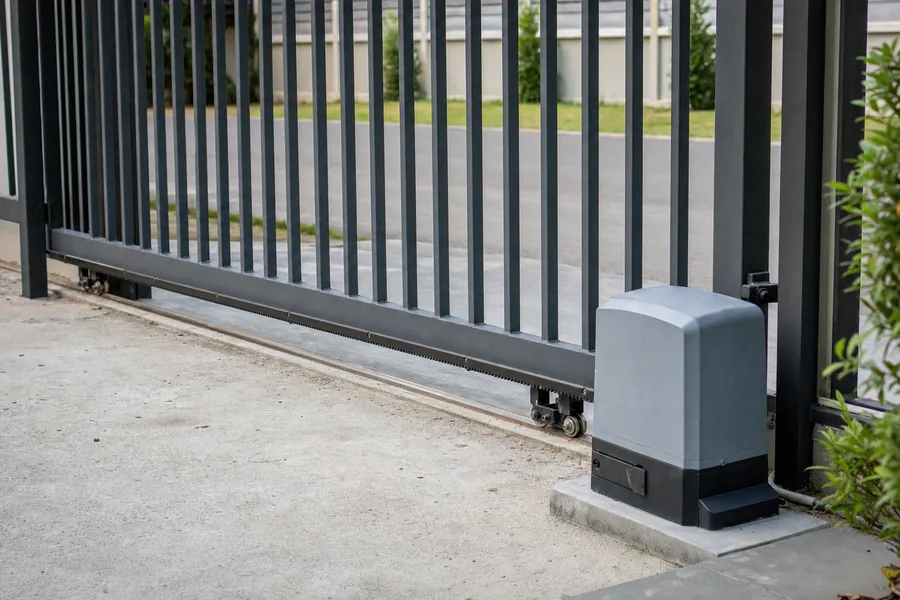
The usual failures, most common first:
Out here, solar operators are the norm wherever the gate is too far from the house to trench power. The panel feeds a battery, and the battery does every bit of the work. An aging battery holds less each season, so the gate manages fewer trips, then goes dead after a few overcast days.
Hardwired units have their own weak point: the low-voltage run from the house or transformer to the gate. Rodents, shovels and years in the ground damage it, and a gate that loses power intermittently often has a failing wire run.
In this climate, a panel coated in dust or shaded by a tree that has grown since installation charges far less than it should. Cleaning and repositioning are part of every solar service call.
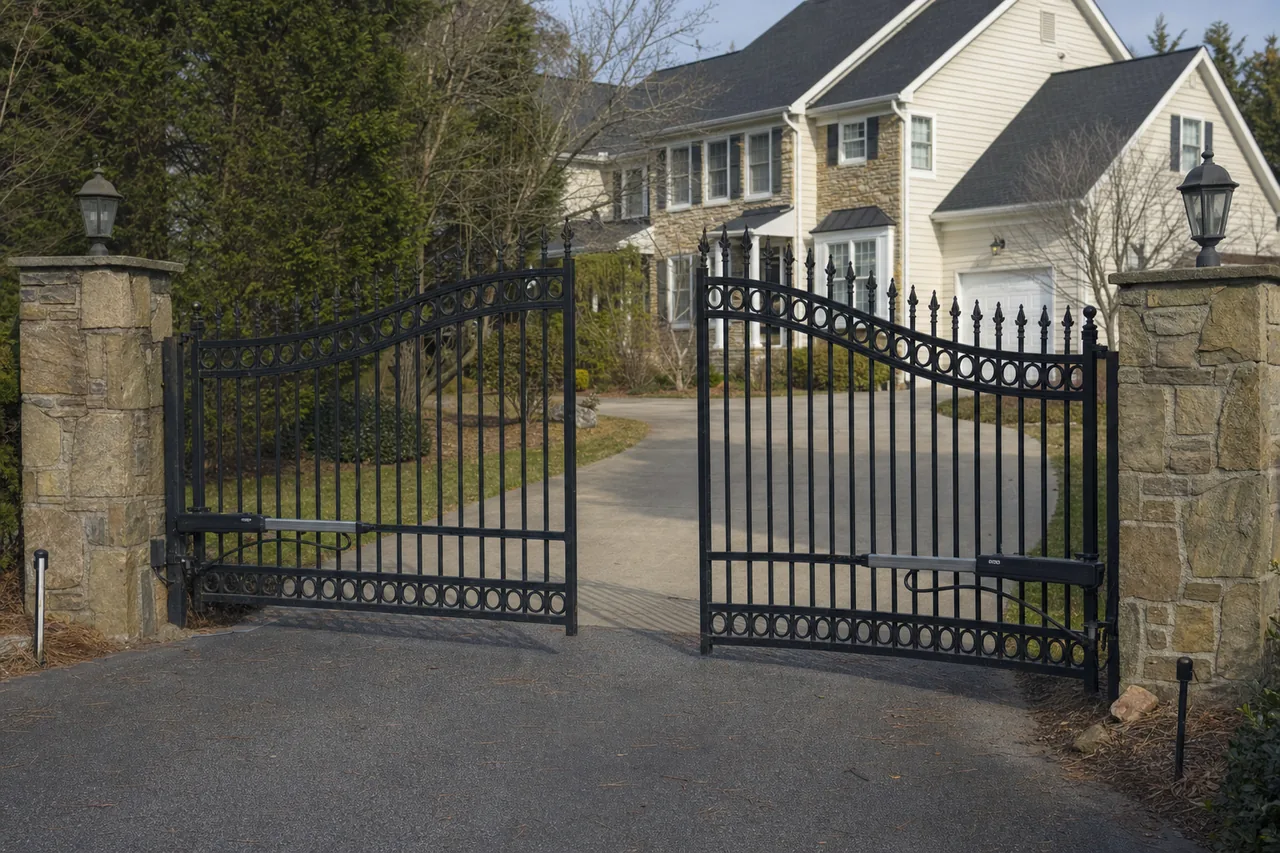
Straight-arm and folding-arm swing units, arms for gates hung inside their pillars, buried operators, chain and rack sliders, and heavy commercial units on orchard and shop gates. We work on all of them.
Paired gates bring one more failure: the timing between the two leaves. When one starts too early or too late, they collide or miss the latch, so resetting the sequence is part of the job.
Timing trouble often starts after one leaf's arm is replaced or a limit drifts on one side only, so both arms are checked together.
When a gate opens and then refuses to close, a safety device is usually reporting trouble: a blocked or dusty eye, a damaged edge, or a loop that thinks a car is sitting on it. The operator is behaving correctly.
Operators are built so that any doubt keeps the gate open. That's correct, and the cure is to repair the device, never to disconnect it.
If a safety device keeps failing, the technician looks for the reason, whether a sprinkler hitting a lens, a loop cut by landscaping, or an edge crushed by a trailer.
The same five questions get asked of every operator, because identical symptoms can hide different faults.
Keypad at the post, remote on the visor, wand beside the drive, intercom at the house, app on the phone: every one of them lands on a single input on the board, so tracing starts at the board and works outward.
Before the technician leaves, each device that's meant to open the gate gets tested, the exit loop and any emergency access included. Remotes get tried from the end of the drive, not just beside the post.
Batteries, boards, capacitors, limit switches, eyes, receivers and keypads are all repairs, stocked for the common makes and usually finished on the spot.
Whatever goes in, the gate must swing or slide freely by hand first. An operator can only be as good as the gate it drives.
A gate that has started to sag or drag is fixed first, and the operator is judged afterward.
Desert sun bakes seals, cracks keypad buttons and cooks boards inside dark housings. Cold nights stiffen grease and slow gates that ran fine all summer, and wind drives dust into tracks, hinges and photo eyes.
Keypads out in full sun crack and fade; the rubber buttons stiffen and the numbers wear away. They're one of the parts we replace most often on valley gates.
Calls here follow the calendar, and so does the stock on the truck: batteries and capacitors when it's hot, eyes and tracks when the wind blows, stiff arms and sluggish gates once the cold settles in.
Clay ground adds a slower problem. Posts and loops set in soil that swells and shrinks move over the years, and a gate that was hung true when installed can end up dragging.
On house gates here we mostly find Ghost Controls, Mighty Mule and LiftMaster; heavier and older installs run Eagle, FAAC, DoorKing, Viking, US Automatic, Elite and Nice Apollo. Parts for the common ones come along.
Tell us whether there's a light on the operator, whether sun or house current powers it, whether the panel is dusty or shaded, and whether you hear a hum, a click or nothing. That decides what we load.
Please keep the covers closed and every safety device connected; everything past that is the technician's job.
Seldom. The usual cause is a safety device: an eye knocked out of alignment or coated in dust, a damaged edge, or a faulty loop. Each device gets tested separately so nothing is replaced on a guess.
Yes. A solar unit is a battery kept charged by a panel; we carry batteries and test the panel, the charge controller and the wiring between them. Panels get cleaned and checked for shade on the same visit.
Ghost Controls, Mighty Mule, LiftMaster, Chamberlain, Eagle, FAAC, DoorKing, Viking, US Automatic, Elite, Nice Apollo and most others.
No. The device gets repaired. A gate closing with its entrapment protection disabled puts people and cars at risk.
Usually. Batteries, boards, capacitors, eyes, receivers and keypads for the common makes travel with us. A gate stuck open moves to the front of the line.
No. You get the diagnosis and the plan before any work begins, and if parts have to be ordered, you know before we leave.
Both, on the same visit. This page covers the operator side; the gate itself, its hinges, rollers and posts, is covered on our gate repair page. Many visits end up covering both.
One call puts you on the route with a two-hour arrival range, and the technician calls when leaving the previous job. We don't buy leads, and nobody diagnoses a gate by phone.
The estimate is free, and it comes before any work.
A two-hour arrival range instead of a whole day, and a call before the technician heads over. Free anywhere in Mesa County.
Want to talk instead? Call (970) 238-2833.
Solar or wired, and what it does now. The estimate is on the house.